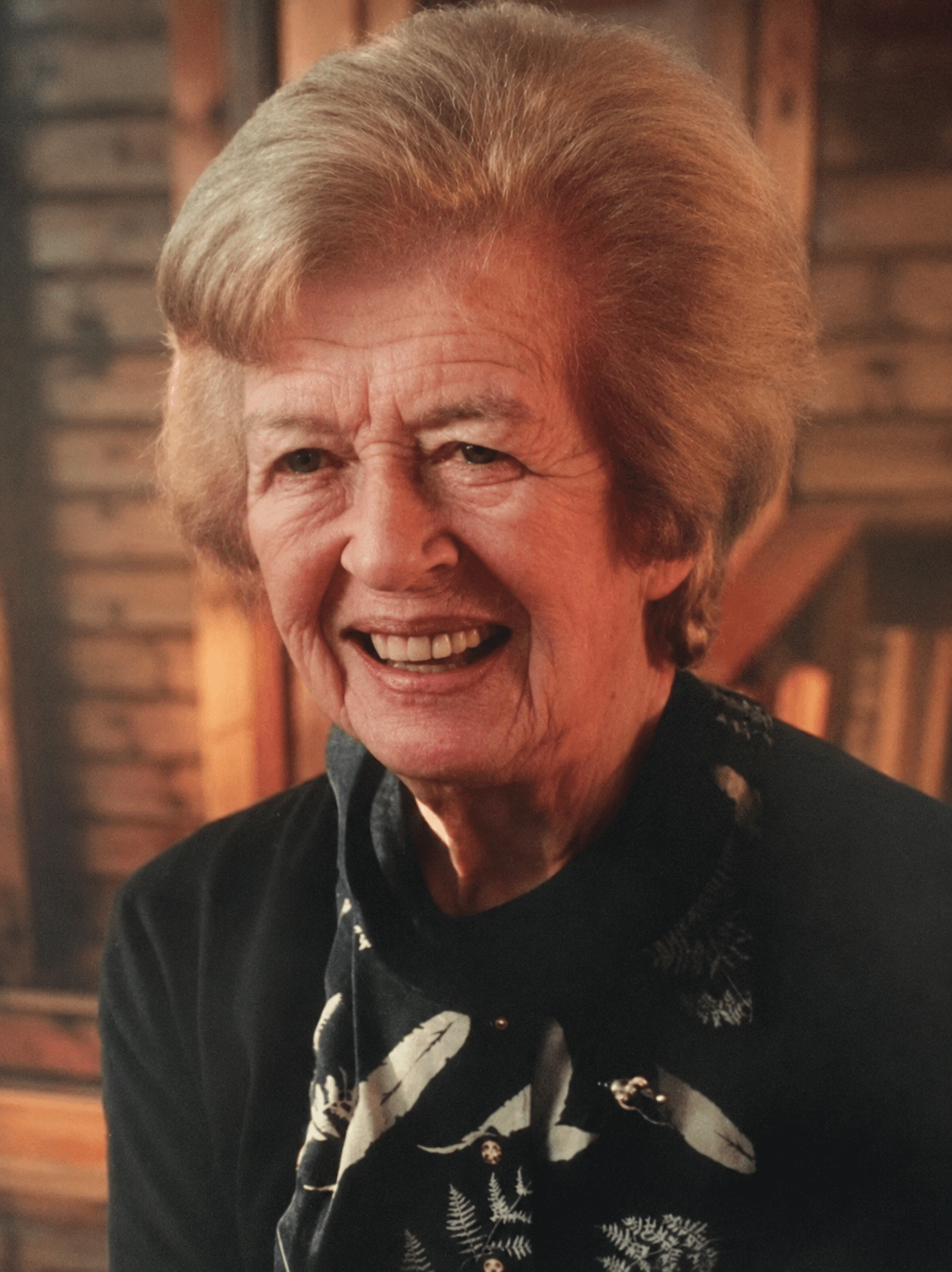
‘I was born on 12 January 1922 in Zwolle, the Netherlands. My father had a jeweller’s shop in a small village, but when I was still young, we moved to Amsterdam, where he started a larger business. My parents were Simon van der Sluis and Bertha Heijman. I have one brother Simon who was born in 1928.
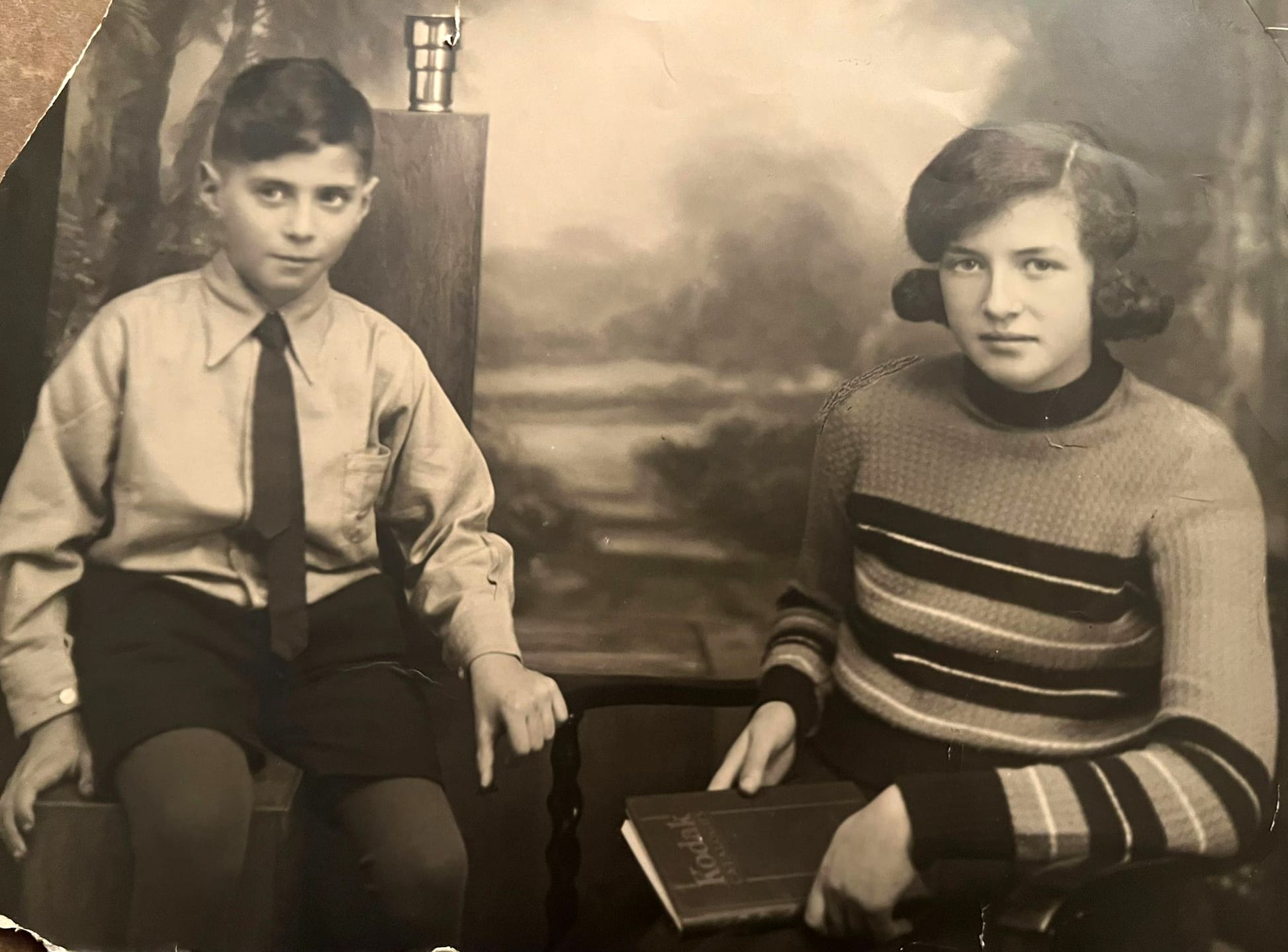
I went to a general high school, where there were many Jewish pupils. At the same time, I was active in Jewish youth life. In the beginning, I belonged to an Orthodox youth club that was not Zionist and not political. It was called Tse’irei Teimon. Later, when I was about seventeen or eighteen, I became a member of Zichron Ya’akov.
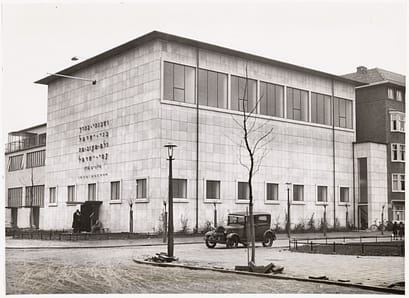
We were also connected to the Lekstraat Synagogue, where we had a youth Beit Knesset. It was a very important place for us. We learned a great deal there and attended shiurim. The boys, including my brother, sometimes served as chazanim. We had beautiful services on Friday evenings and on Shabbat mornings, and the atmosphere was very warm and meaningful.
At home, we were traditionally religious. My father came from a religious family and my mother from a very religious one. We were not strictly observant, but we continued the traditions in our daily life.’
The German Invasion and Its Immediate Impact
‘On the morning of 10 May 1940, when the Germans invaded the Netherlands, we had to be at school at eight o’clock. The entire school gathered in front of the building. Our principal spoke to us and said that he foresaw a very difficult time for the people of the Netherlands. He was a kind man and wished us good luck. I do not remember his exact words, but he expressed the hope that everything would eventually turn out well.
I also remember our bookkeeping teacher, a very quiet man who never spoke about anything other than his lessons. That day, he said only one thing: that we were entering a difficult time and that we would continue quietly. After the war, I met him again at a reunion, and he told me that he had hidden a Jewish girl in his home. That revealed to me what kind of man he truly was.
On 10 May 1940, it was my last day at school. My final exams were only about two and a half weeks away, so it was a very difficult time. In those first days of the war, my mother was in great distress and at one point even wanted to take her own life. I stayed close to her all the time because I was very frightened, and this made it hard for me to prepare for my exams.
Nevertheless, I managed to continue. The written exams went as they had to, but during the oral exams many of the teachers were very kind to the Jewish pupils. In the end, I passed my final exams.
My brother went to a Jewish high school. Each day he came home and told us that there were fewer children in his class. One of his classmates, a boy of about twelve or thirteen, took his own life together with his parents and siblings. During those first days of the war, we heard many such tragic stories. Some people tried to flee to England; others went as far as IJmuiden but were forced to return. A few managed to escape, but many did not.’
Life Under Increasing Restrictions
‘After those first shocking days, life continued under increasing restrictions. I began working at a Jewish accounting firm. After six months I started working as a secretary at the Central Jewish private hospital. Gradually, more and more German regulations were imposed. We were no longer allowed to use public transport, we could not be outside after eight o’clock in the evening, and we were forbidden to visit non-Jewish people. Then we were forced to wear the yellow star.
Around that time, one of my mother’s sisters came to live with us. One day, my parents returned from the Jewish market and found that two men had just left our home. They had taken my aunt. One day, my parents returned from the Jewish market and saw two Dutch SS’ers leaving our house. They had taken my aunt away from our home. We never saw her again.’
Work at the Jewish Hospital and Growing Persecution
‘From March 1941 until February 1943, I worked at the Jewish hospital. During that time, I also studied English correspondence and passed my exam. Earlier in the war, I had already taken exams in shorthand and typing.
The deportations intensified in 1942 and 1943. We saw what was happening around us. People were being taken away continuously.
I continued working in the hospital until the Germans arrived with a demand that I could not accept. They wanted to sterilize Jewish men, especially those married to non-Jewish women. I refused to cooperate. Although I was responsible for administration, I could not be part of this. I left the hospital without formally resigning and stayed at home.’
Temporary Protection from Deportation and Escape from Arrest
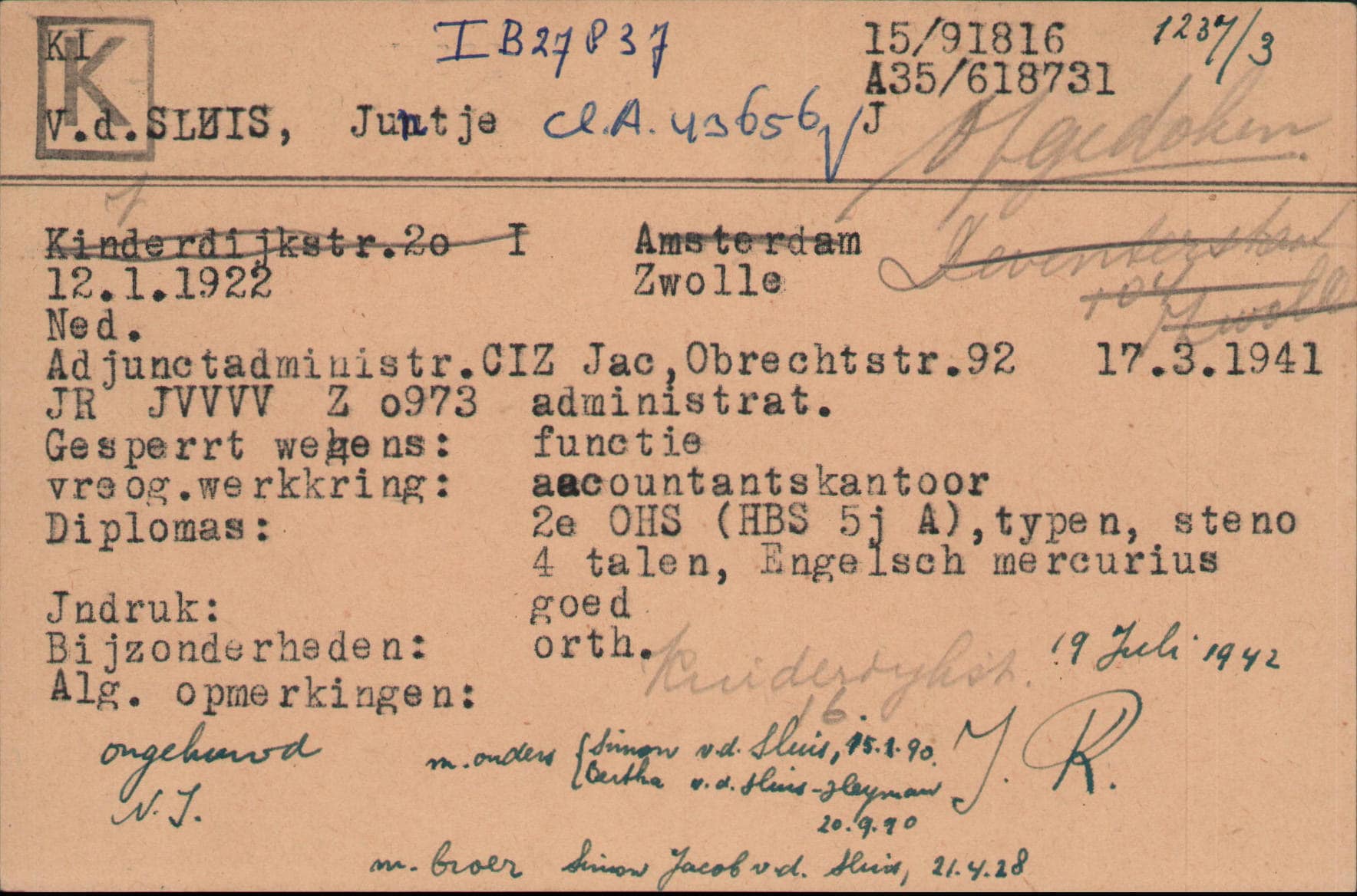
‘My father had obtained a temporary exemption from deportation. He visited poor Jews and distributed money on behalf of the Amsterdam council. He also worked as a supervisor in a vegetable shop in the Jewish quarter. Because of this and because of my work in the hospital, we were for a time spared from deportation.
One evening, Dutch Nazis came to our home and ordered my father, my mother and my brother to report to a certain square. When I heard them coming, I ran upstairs and climbed onto the roof. People living on the top floor heard movement and thought there was a thief. When they found me, they took me into their home. They knew us, as they were clients of my father. I was extremely frightened and trembling. I went back to our home for the night, and the next morning at seven o’clock I heard my brother whistling. My parents and brother had come back because of my father’s “Sperr”.’
Loss of the Family Business

‘Around this time, my father was also forced to give up his shop. A German “Verwalter” was appointed to take control. He was not a particularly harsh man and allowed my father to keep the keys, saying that he trusted him. Meaning the Verwalter trusted my father not to take our own things from the shop. Of course, my father managed to take a few things but he was too scared. You see this large clock here. That was a “private clock”. At the end of each week, however, all the money was taken away. We were no longer allowed to run the business or to buy new goods. In the end, we had to give up everything.
We were forced to move to another apartment. Later, a Dutchman who had previously owned a small shop in the same street took over our shop. Years afterwards, I saw that he had expanded it into a large and successful business, but I could never bring myself to enter it again.’
Into Hiding
‘Life became increasingly uncertain. My parents were very afraid. At one point, we took in a boy from our youth club whose family had been deported. We also knew that my father’s youngest brother and his wife were somewhere in hiding, though we did not know where.
Then, in May 1943, on a Shabbat afternoon, two men came to our house with a letter from my uncle. He wrote that we could trust them. They asked us to consider going into hiding and said they would return in a few days.
On Monday, we received a German order to report with a rucksack for labour in Poland. The next morning, the men returned. It was 25 May 1943. They told us to meet them that evening, at six o’clock, under the clock at the central station, and not to forget to remove the yellow star.
We didn’t really have long discussions about whether to trust those people or whether to go into hiding. Because of the letter from my uncle, we felt we could trust them, and we decided to go. The boy who was living with us didn’t want to come. He believed he could still help his parents, who were in Westerbork. He walked with us for a few minutes and we tried to convince him, but he refused. He didn’t come back.
It wasn’t far from the central station. We walked through a dark street, where we took off the star and simply continued on. We had no luggage, because we had left everything behind. We didn’t even lock the door. Afterwards, the neighbours came and took many of our belongings: furniture, clothes. We had thought they were nice people, but they were not.
Two men from the underground came again, and I had to pretend that I was engaged to the younger one of these two men. We walked arm in arm, acting as if we were very much in love. That was how we boarded the train. Inside, we met another man from the underground, together with a nurse I recognized from the Jewish hospital. She was a private nurse and sometimes worked in different hospitals.’
Arrival in Friesland
‘We didn’t know where we were going. The train went north. It was already dark when we arrived in Heerenveen. There we got off and had to take a tram. It was very late – around ten-thirty, eleven o’clock – and I will never forget the conductor. He wore glasses like mine. The man who had accompanied us from Amsterdam told us, ‘Now we leave you on your own. You must say: “Vier enkele Langezwaag.” Which translates: Four one-way trips to Langezwaag.
We said it, and the conductor looked at us over his glasses and repeated, “vier Langezwaag.” Of course, they had sent us on that tram because they knew the conductor and trusted him. And because we spoke Dutch, he immediately knew we were Jewish. Everyone in that region spoke Frisian, not Dutch.’
Reaching the Hiding Place
‘After getting off, we had to walk a long way through a meadow before we reached a farm. We didn’t know what to expect. And then we saw them: our aunt and uncle. We cried and embraced each other.
The next morning, at five o’clock, I heard a voice: the farmer waking his son to milk the cows. Only then did I realise that the farm was actually close to the road. The night before, we had been made to walk through the meadow simply to avoid being seen.
We stayed there for two weeks. After that, a different hiding place was found for my parents and my brother, on another farm. Those people were communists, at least until after the war, and they were wonderful. For me, they found a place as a servant, because none of us looked “Jewish”.’
Ternaard
‘I worked in the far north of the country, in the village of Ternaard near Dokkum, for about six months. It was not a pleasant time. After that, I went back to my parents for two months.
In Ternaard, I worked for a young couple. The woman was unhappy there. She came from Utrecht, and in those small villages hardly anyone was called “Mrs.”. Only the mayor’s wife, the notary’s wife, or the doctor’s wife were addressed that way. Farmers’ wives were called “Frau”, and the wives of teachers and shopkeepers were called “Miss”. She disliked the fact that she was no longer “Mrs.”. Still, they did important work; illegal work against the Germans.
Of course she knew I was Jewish. Sometimes I was allowed to write letters to my parents, but she insisted on reading them. Now and then I would include Jewish words, and when she asked what they meant, I told her they were family expressions that only my parents would understand. I also received letters from my parents. They realised my life was not easy. During those months, I lost about thirteen kilos.
I had to work very hard. She stayed in bed in the mornings and treated me like a real servant. When they had guests staying for several weeks, I had to eat in the kitchen. I made a vow to myself that if I ever had a servant, I would never let her eat separately in the kitchen.
This couple had one little girl who was two years old and she was pregnant. He had been a teacher in Rotterdam. But when his father, who had a shop in Ternaard, died, he had to go back to Ternaard to manage this shop because his brother and sister were too young.’
A New Identity: ‘Bep Bos’
‘I had false papers, of course. My name was changed. I became “Bep Bos”, supposedly from Amsterdam. There was one mistake on my identity card: the street mentioned was in a Jewish neighbourhood, and I believe that address no longer existed. Perhaps that is why it was used. Everyone called me “Bep”.
The notary’s wife, an elderly woman, had a Jewish baby in her home. Sometimes I visited her. I was also asked to sell postcards of the royal family. I hid them among my clothes, cycled from farm to farm, and said, “I have something nice for you: postcards of the royal family.” I collected the money and handed it over to the people I lived with, who then passed it on to the underground. In that way, I could contribute a little to the resistance.
Every evening I also had to buy milk. I took my bicycle and I searched for farmers willing to sell it and returned home with eight bottles. So, unlike many others in Holland, I was never really hungry.’
Adapting to a Christian Environment
‘No one ever questioned where I came from. I simply said I had left Amsterdam because of the food shortages there. The family I lived with were religious Christians, and I had to go to church twice every Sunday. In the beginning, that felt very strange. Like everyone else I took a hymnbook to the services. On the wall of the church was written which psalm and which song were sung. I looked up the numbers of the psalms and hymns in the hymnbook. I memorised them quickly, and sang along.
After a few weeks, a visitor remarked, “Bep sings just like all of us.” I learned quickly. Every day after the main meal, my host read from the New Testament, sometimes also from the Old Testament. The first Sunday I attended church, the minister – who also knew I was Jewish and was involved in illegal work – based his sermon on a passage from the Old Testament especially for me. That meant a great deal to me.
Each Sunday, my hosts would ask what the minister had preached about. Often I had difficulty staying awake – I was exhausted from the work – but I tried to listen. I also had to join the Christian girls’ club. We knitted socks for an annual bazaar. Each week, the minister’s wife read a chapter from the New Testament, and the following week one of the girls had to write about it.
I became increasingly anxious as my turn approached. I had never done anything like that before. Then one evening she said, “Next week it’s your turn, Bep,” just as she said to all the others. The passage was about the entry of Jesus into Jerusalem. I went home and told my host that I had to write something. He said, “Of course you can – you went to high school.” So I tried to write it in the same rather dull way as the other girls, and I succeeded. I even read it aloud in the same tone. The minister’s wife simply said, “Thank you very much,” just as she did to everyone else. And so I managed.’
Heerenveen
‘I remained in that same house until December 1943. Then, one day, she told me that the Germans began to grow suspicious and that I had to leave. After that, I stayed for some weeks with my parents, and then for about two months with the family of the man who took us from Amsterdam – a wonderful man.
This was in Heerenveen. They had a ten-year-old son who was wonderful – he seemed to understand everything. There was also another Jewish woman living in the house. After about two months, they found another place for me in Leeuwarden, the capital of the province.’
In Ternaard, I had already begun to learn how to adapt. I made a few girlfriends, and on Sunday afternoons we visited each other. I also learned their customs, even something as simple as how to drink coffee or tea properly. The first cup was always normal, but if you wanted a second, you left the cup on the saucer. If you didn’t want more, you had to place the cup slightly askew or turn it upside down. At first I didn’t understand why they kept refilling my cup – I simply didn’t know the rules.’
Leeuwarden: Life Within the Resistance Household
‘The second family I stayed with in Leeuwarden were wonderful people. The first time I wanted to write a letter to my parents, I asked my hostess if she wanted to read it. She looked at me in surprise and said, “Why? When you write to your parents, that is not my business.” When I told her how it had been before, she became quite angry. “Your letters are your letters,” she said. “You can write whatever you want. And when you receive letters, just give them my regards.” They treated me with great respect.
It was in that house that plans were made for what later became known as “the overfall” – the prison escape in Leeuwarden. There were meetings of the underground several times a week. I did not know the details at the time, of course. I was still working as a kind of servant, but they treated me as a member of the family. They had six children, and there was another servant who was very kind to me and taught me many things. It felt like a real family life.
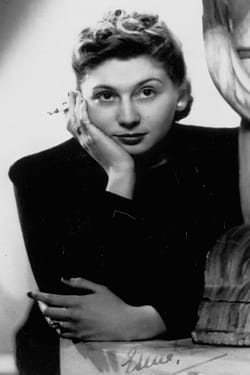
They were Mennonites. They never went to church. I think the eldest daughter knew that I was Jewish. The family had a large carpenter’s yard, almost a factory, and that was where the underground meetings took place. When people stayed overnight, I had to make their beds. One morning, when I lifted a pillow, I found a pistol underneath. I was not afraid. I trusted the people in that house. Among the members of the underground was even a policeman, though I did not know their real professions at the time. Many of them had stopped working in order to resist the Germans.
There was also a young woman staying there, from a noble family – Miss Van Eeghen. She acted as an intermediary. She was friendly with the Germans but also worked for the underground. She was very pretty. Later I learned that she had betrayed the leader of the group, who had already fled to Amersfoort. When the Germans came for him, he shot himself, because he had always said they would never take him alive.’
Elderly Couple
‘Before the overfall took place, I had to leave because the family I was with, had to go into hiding. They moved onto a houseboat they had built themselves at the yard. I went to stay with an elderly couple who did not know who I was, and never found out.
It was not a pleasant place. The house was dirty, and I had to care for the old woman. They even went to bed fully dressed, as they had been during the day. I could only bathe once a week. After some months, I could not bear it any longer. I was terribly lonely.
I then went to the sister of the woman from the carpenter’s yard. This was in 1944, shortly after the invasion in Normandy. While I was with the elderly couple, I had become friendly with a farming family. Their son was very kind to me – almost like a boyfriend. When I left this elderly couple, I do not remember what excuse I gave. Perhaps I said I had to go to my parents.’
New Family in Leeuwarden
‘The new family in Leeuwarden were also kind. The man was a carpenter, with his workshop downstairs. They treated me well. From there, I was sometimes able to visit my parents by bicycle – on wooden tyres, because there was no rubber anymore. Even my shoes had wooden soles.
One day, I had to bring coupons for the underground in Heerenveen, for the man who had helped us from Amsterdam, as well as clothes for Jewish children. Everything was packed in a bag on the back of my bicycle. Just outside Leeuwarden there was a wall known locally as the “Mauer muur”, where the German Feldgendarmerie checked everyone leaving the town. I was very nervous, carrying all those things. Then, about fifty metres before the checkpoint, one of my pedals broke. I had no choice but to turn back. My host repaired it, and after some coffee I set off again. When I reached the wall, the Germans had gone. There was no one left to check me. I can only say – it had to be like that.
I continued to Heerenveen, delivered what I had brought, and then went on to my parents. I stayed with them for two days before returning to Leeuwarden. I remained there until 15 April 1945, when the city was liberated. The next day, my brother came to fetch me and took me back to my parents.’
Liberation
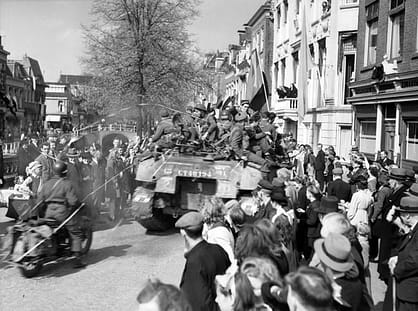
‘I remember the day of liberation very clearly. There were red, white and blue flags everywhere. Everyone was excited – people were dancing in the streets. I saw Jewish people I knew from Amsterdam coming out of the houses where they had been hiding. One girl I had already seen before; we had passed each other in the street and pretended not to know one another. Now everything was different – everyone was overwhelmed with joy.
There were no fights in Leeuwarden. Of course, Dutch people arrested girls who had been friendly with German soldiers and had their hair cut, but I didn’t see that myself. I stayed away from the centre of town.
The Canadians liberated Leeuwarden. A few days later I went to a party in a hall in town, and I remember dancing with a Canadian sergeant. Soon after, when I came back to my parents and brother, I wanted to help the Dutch resistance, the former underground. They accepted me, and I started working as a secretary.’
After the War: Loss and a New Beginning
‘Every day, lists were made of Jews who were still alive. These lists were posted in Heerenveen, outside the office where I worked. My brother came there daily as well, hoping to find the names of relatives or friends. But apart from one aunt and uncle who had survived in hiding, no one else from our family returned.
We had some idea, even during the war, of what had been happening in Poland and Germany. A cousin of my parents had been taken away, and shortly afterwards we heard he had died. We already knew the name Auschwitz. After the war, we learned about the other camps. We were very lucky – my parents, my brother, and I had survived. That was not the case for most Jews.
After working for the former underground, I worked as a secretary in an office that registered young men who volunteered to go to the Netherlands East Indies as soldiers. This was still in Heerenveen, where I had a room. My parents and brother returned to Amsterdam, and I joined them a few months later, in August 1945, once they had found a flat.
My parents then told me to visit the Duitscher family. We had known them since I was seven years old. Mr. and Mrs. Duitscher invited my parents for dinner almost every evening. They were living in a temporary flat in the former Jewish area, and my mother told me, “You have to go there to say hello to them. They have been very kind to us.” That is how I met my future husband, Meijer (Max) Duitscher.’
The Girl from Ternaard
‘I often thought back to the girl in Ternaard, my first hiding place. Her name was Bertie de Miranda. She was eleven years old and was not supposed to know who I was. I knew she was Jewish, but she did not know that I was. She only knew I came from Amsterdam. When we were alone, we talked about the city, and she loved to speak about her parents and her life in the Jewish neighbourhood. We became close. Bertie called the couple in Ternaard aunty and uncle.
After the liberation, Bertie was told she had to leave. She did not know where to go. She was only thirteen then, on her own. Eventually she was taken to Amsterdam, where a Jewish organisation for war orphans, “Le-Ezrat HaYeled”, arranged for her to stay with a couple who had no children.
When I got married I asked Bertie to be my bridesmaid because there were no cousins or nieces or nephews left.
Later she moved to another family in Rotterdam, who were very kind to her. She eventually married. Her sister stayed in Friesland and converted to Christianity.’
Loss of the Extended Family
‘From my wider family, no one returned from the camps. One of my father’s brothers, his wife, their daughter and her husband had been in hiding in Meppel. The man of the house where they stayed had been forced to work in Germany, but when he returned home on leave, he refused to go back and went into hiding himself. The Germans came looking for him, and his wife, out of fear, revealed that there were four Jews hiding in the attic. They were taken away. None of them survived.
Another brother of my father and his wife were also captured. In the end, only my father’s youngest brother survived.’
To Israel
‘After the war, I was no longer Orthodox. I had lost much of my faith because of everything that had happened. We raised our children in a somewhat traditional way. They went to a general elementary school and later to the Jewish Maimonides Lyceum. My husband had always wanted to go to Palestine. After the war, we decided we would go to Israel, but only after our parents had passed away.
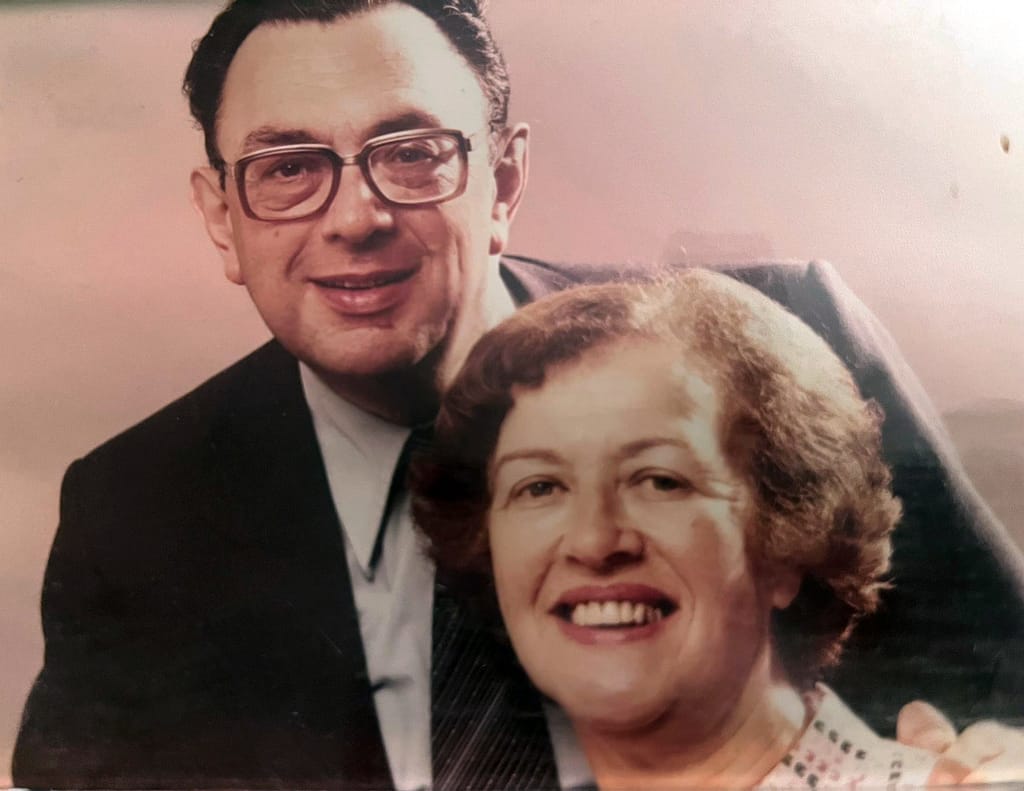
My brother went to Israel in 1947. Years later, after my mother-in-law died in January 1985, we finally made aliyah ourselves in November of that year. We had first visited Israel in 1963, together with our children, so they would understand what the country meant to us and to the Jewish people.’
Yad Vashem
‘We always remained in contact with the people who had helped us during the war. Some of them were later recognised by Yad Vashem. Hendrik Marcus De Jong, who had done a great deal of illegal work, received such recognition. He had even managed to place a Jewish couple in the home of Dutch Nazis, promising that they would not be imprisoned after the war if they helped. They agreed – and they treated the couple well. After the war, he kept his word and ensured the man was released after only a short time in prison.
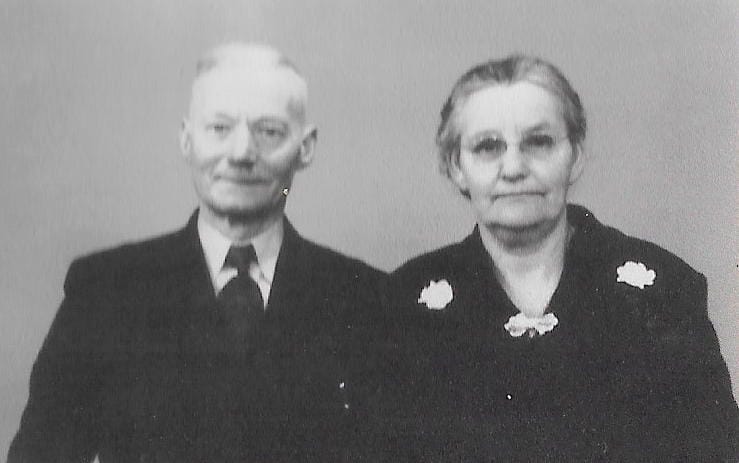
The son of the family who had helped us escape from Amsterdam visited Israel with his wife. My brother and I paid for their trip, out of gratitude. We stayed in touch with all these people over the years. Even now, I still receive letters. We visited them, and they visited us. The bond remained – for life.’
Juutje Duitscher passed away in 2011.